Thursday, November 22, 2007

10 Quick Branding Tips


Branding is very important in business and here are 10 quick tips for your business to think about branding:

1. Brand excels at delivering the benefits consumers truly desire
Give the customers what they really want.

2. The brand stays relevant
Keep updated with the times and trends.

3. The pricing strategy is based on consumer perceptions of value
Set prices your customers would expect for the quality of your product.

4. The brand is properly positioned
Make your product different than the competition and emphasize your most desired attributes.

5. The brand is consistent
All programs and efforts about the product should have the same message.

6. The brand portfolio and hierarchy makes sense
All brands underneath are understood and related.

7. The brand makes use of and coordinates a full repertoire of marketing to build equity
Use many outlets to get the word out.

8. The brand’s managers understand what the brand name means to consumers
Finding out what your customers like and do not like about your brand.

9. The brand is given proper, sustained support
Make sure you understand why marketing programs work or do not work before changing them.

10. The company monitors sources of brand equity
Have something written to make sure everyone understands the meaning and equity of the brand and how it should be treated.

Baby Alarm Strategic Planning Activities


Baby Alarm is a new product that detects if there are harmful odors in the air and sends out a signal if an infants gets too close to them and is in danger. I have been asked by my boss to come with 10 strategic planning activities for our company to perform.

1. The Value Chain

This is vital in creating more customer value. The value chain is a synthesis of activities to design, produce, market, deliver, and support for a product. This is important for Baby Alarm because the company needs to make sure every department is in sync and all working towards the same outcome.

2. Core Competencies

These are the companies resources such as labor, materials, assets, and information. Core competencies are a source of competitive advantage that is significant enough that is difficult for competitors to imitate. Baby Alarm should find one or two core compentencies to utilize its resources to gain an advantage over its competitors.

3. Marketing Plan

The marketing plan is the central instrument for directing and coordinating the marketing effort. Baby Alarm needs a plan if they want to be successful.They need to figure out what they want to advertise, how they want to advertise, and what methods to use to advertise.

4. Corporate Mission

Creating a corporate mission helps a company see what its ulimate purpose for being in business. This lets the company know why they are there and its main goal. At Baby Alarm, the ultiate goal to create a life saving alarm for young children and to keep them safe from harmful chemicals.

5. Assessing Growth Opportunities

The purpose of this assement is to figure out plans for a new business, downsize an exisitng business, or terminating a business. Baby Alarm should determine if there are growth opportunities to they can expand its business.

6. SWOT Analysis

This is determining a business’ strengths, weaknesses, opportunities, and threats. A business can see where they are strongest, and what they can improve on. Perhaps Baby Alarm strongest point is its product, and its weakest is its lack of advertising.

7. Deciding to go Global

More and more companies are deciding to go global. This allows them to expand into different markets and increase its sales. Baby Alarm should consider going globally since there are babies all over the place, and most people would like to protect their babies from harmful chemicals.

8. Goal Formulation

An important activity a business should do is figure out its goals. It is similar to a corporate mission, but goals are specific with time frames. Baby Alarm could form a goal to increase sales by 20% by the end of the year.

9. Analyzing consumer markets

Consumers are different in many ways and Baby Alarm should understand the differences between consumers. Some consumers are highly influenced by family members. Some consumers are really concerned with safety. For Baby Alarm, they should consider markets who are concerned with safety and family.

10. Identifying target markets

Baby alarm needs to identfy which markets they want to target. The better they know their target market, they will have a better understanding how to market towards them. A good target market they should consider is new parents.

Top 10 Tools


Here are my personal top 10 business tools:

1. Goal Formation

It is important not only for companies to have goals, but individuals. If you do not have a goal, you won’t know where you are going or how to get there. Here are 4 tips for goals to help businesses stay on track. It is useful for individuals too!
Arrange goals from most to least important – This helps you focus on the big picture.
Objectives should be stated quantitatively – It is better to list a goal with a number so you know exactly what you are reaching for.
Goals should be realistic – You should make your goals achievable, not impossible.
Objectives should be consistent – Do not have goals that are opposites of each other such as “maximize profits” and “maximize sales”

2. Market Research Process

The marketing research involves 6 steps that can be applied to any research process. This is useful for businesses when trying to learn more about a situation. The 6 steps are:
Define the Problem
Develop the Research Plan
Collect the Information
Analyze the Information
Present the Findings
Make the Decision

3. Questionnaire Dos and Don’ts

Marketing involves a lot of surveying so it is import that you formulate your questions carefully. Here are some Dos and Don’ts when writing your questionnaires:
Ensure that questions are without bias
Make the questions as simple as possible
Make the questions specific
Avoid jargon or shorthand
Steer clear of sophisticated or uncommon words
Avoid amigous words
Avoid questions with a negative in them
Avoid hypothetical questions
Do not use words that can be misheard
Desensitize questions by using response bands
Ensure that fixed responses do not overlap
Allow for “other” in fixed response questions

4. Buying Decision Process

It is import as marketers to understand the consumer buying process so that we can talor marketing plans accordingly. This is how the buying process goes:
Problem recgonition – The buyer recgonizes a problem or need.
Information search – The buyer will then obtain more information.
Evaluation of alternatives – The buyers looks at many options to see which will suit most or all of their needs.
Purchase decision – The buyer makes a final decision on a product or service.
Postpurchase behavior – The buyer may feel happy or remorse after purchasing a product.

5. Segmentation Process

Marketers need to know how to segment the market. This allows for better marketing and easier to market to only the people who would be interested in your product. There are 7 steps in the segementation process:
Needs-Based Segmentation – Group customers based on similar needs and benefits.
Segment Identification – For each segment determine which demographics, lifestyles, and usage behavior make this segment unique.
Segment Attractiveness – You can find this information such as market growth and competitive intensity.
Segment Profitability – Determine how much money the segment will bring.
Segment Positioning – Create a value proposition and product-price positioning strategy.
Segment “acid test” – Create storyboards to test the attractiveness of the strategy.
Marketing-Mix Strategy – Expand the postioning strategy to include all aspects of the marketing-mix such as product, price, promotion, and place.

6. Brand element choice criteria

Creating a brand is very important in marketing. Brand is what your customers will know and remember. There are 6 things a brand should be:
Memorable – Easy to remember
Meainingful – Relates to the product category
Likeability – How pleasing is it to the consumer
Transferable – Able to introduce new products and go global
Adaptable – How updated and adaptable in the brand
Protectible – Able to legally protect the brand

7. Product Life Cycles

It is important for marketers to realize the life cycles of products. Each stage requires a different marketing approach. The 4 stages of a product life cycle are:
Introduction
Growth
Maturity
Decline

8. Service Marketing Checklist

In service marketing, there are certain questions marketers need ask themselves to make sure they are achieving its marketing objectives. These questions serve as a checklist:
Do we strive to present a realistic picture of our service to customers?
Is performing the service right the first time a top priority?
Do we communicate effectively with customers?
Do we surprise customers during the service process?
Do our employees regard service problems as opportunities to impress customers?
Do we continiously evaluate and improve our performance against customers’ expectations?

9. Setting the Price

Marketers need to know what prices to set. The success of the business depends on the price of a product or service. Too high of a price might create a low demand, and too low of a price may create inventory shortages. There are 6 steps in setting the price:
Selecting the Pricing Objectives
Determining Demand
Estimating Costs
Analyzing Competitors’ Costs, Price, and Offers
Selecting a Pricing Method
Selecting the Final Price

10. Helping Stores to Sell

Marketers also need to realize not everyone shops the same and there are some tips employees could use to help stores sell:
Attract shoppers and keep them in the store
Honor the “trasition zone”
Don’t make them hunt
Make merchandise available tp the reach and touch
Men do not ask questions
Women need space
Make checkout easy

Sample PG&E Survey


1. Overall, how do you feel about PG&E’s as a company?
[ ] Excellent
[ ] Very Good
[ ] Good
[ ] Fair
[ ] Poor

2. Please rate your overall satisfaction with PG&E’s new energy program
1 2 3 4 5 6 7
Unsatisfied Neutral Satisfied

3. How important is it energy efficiency in your home?
1 2 3 4 5 6 7
Not Important Neutral Very Important

4. How likely are you to upgrade your appliances if it reduced your energy costs?
1 2 3 4 5 6 7
Unlikely Neutral Likely

5. Where have you seen or heard about PG&E’s new energy program? Check all that apply.
[ ] TV
[ ] Radio
[ ] Website
[ ] Magazine
[ ] Newspaper
[ ] Flyers
[ ] Friends or Family
[ ] Other (please specify) _____________
[ ] None

6. Which of the following is most important when deciding on a new energy service:
[ ] Price
[ ] Customer service
[ ] Environmentally friendly
[ ] Payment options
[ ] Uptime

7. What would you like to see PG&E use in the future? Check all that apply.
[ ] Rebates
[ ] Discounts on new appliance upgrades
[ ] One price payment plan
[ ] Discounts for using less energy
[ ] More service options

8. Rank in order which appliances and electronics you the most, 1 being you use the most often and so on:
___ Washing machine / Dryer
___ Oven
___ Stove
___ TV
___ Computer
___ Microwave
___ Other (please specify) ___________________

9. During a typical 24 hour day in the winter, how long does your heater run?
___ 80 – 100% of the day
___ 60 – 79% of the day
___ 40 – 59% of the day
___ 20 – 49% of the day
___ 0 – 19% of the day

10. For the following statement, rate how much you agree or disagree: PG&E thinks of its customers’ needs when deciding on new energy programs.
[ ] Strongly Agree
[ ] Agree
[ ] Somewhat Agree
[ ] Somewhat Disagree
[ ] Disagree
[ ] Strongly Disagree

11. Please indicate your gender:
[ ] Male
[ ] Female

12. What is your age?
[ ] 18 to 20
[ ] 21 to 25
[ ] 26 to 30
[ ] 31 to 35
[ ] 36 to 40
[ ] 41 to 45
[ ] 46 to 50
[ ] 51 to 55
[ ] 56 to 60
[ ] 61 or older

13. What is your race?
[ ] White
[ ] Hispanic
[ ] African-American
[ ] Asian
[ ] Pacific Islander
[ ] Native American
[ ] Mixed
[ ] Other (please specify) ____________________
[ ] Prefer not to answer
View sample responses and charts for the first 7 questions by clicking this link:

Request for Proposal


This is an example for a request for proposal from PG&E:


I am the marketing manager of PG&E’s Southern Division which covers Bakersfield to San Diego in California where we currently serve 3,400,000 customers. We want to survey our customers to find out their perceptions and attitudes about PG&E’s new energy marketing program. This is a large research project and we have specific requirements to ensure the validity of the project. Requirements are as follows:

- Random survey of the entire Southern region (3,400,000 population size)
- Survey the attitudes and perceptions of PG&E’s new energy marketing program
- At least 98% statistical accuracy
- Survey should utilize many types of scales
- Demographic information required

This is a large project that will require careful analysis and creation of the survey to ensure accuracy of the results to help PG&E understand its marketing efforts. Please submit your bid by mail no later than January 15, 2008. Thank you for your review.

Tasha Pettengill
PG&E Marketing Manager
1005 Main Street
Bakersfield, CA 98000
1-800-777-8888

Critical Elements of a Store-Front Website


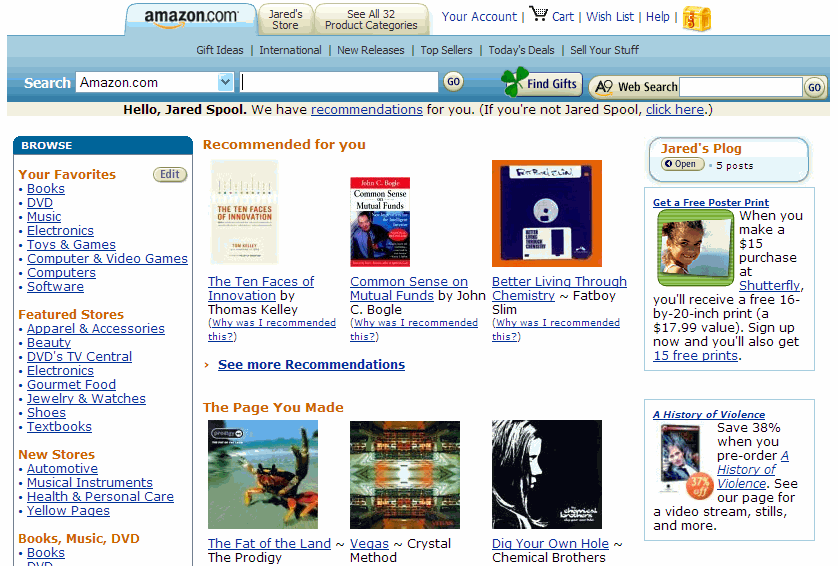
To be successful on the internet, you need to create a good store-front. Here are 10 elements your store-front should contain in order to be successful:

1. Easy Navigation

The navigation bar should be organized, easy to read, easy to understand, and easy to find what you’re looking for.

2. Include related items in displays

When someone searches for a particular product, the accessories and related products should also be included in the search results and/or displayed near the product’s page.

3. Include important information

Customers want to know everything about the product, don’t leave anything out. The more product features you list, the better. Make sure the most important information is seen first.

4. Make purchasing easy

Nothing turns more customers away than making it difficult to purchase. Require as little steps as possible and offer many payment options. Have the ability to save payment information so next time the customer does not have to go through all the steps again.

5. Professional clean look

You have to make your website neat and organized. Customers will click the close page if the website is not pleasing to the eye and professional.

6. Speed

No one likes to wait. Customers are impatient and will give up on your website if it takes too long to load. Use only the essential elements you want to display in your website. This also helps to keep your website simple and easy to read.

7. Layout

Make sure your website is setup in a way that makes sense. People look for the search and navigation at the top of the page. Make sure all the pages are consistent with one another.

8. Product Reviews

People like to read what others thought of a product before they purchase it. Allowing customers post their reviews let other customers know how good the product is and what they liked or didn’t like about it. Reviews can help customers who are on the fence about purchasing a product.

9. Extra services

Customers love getting stuff for nothing. Offer free shipping or gift wrap. These little extras can help win customers over a competitor.

10. Recommendations

Your website should recommend similar products based on the customer’s search results. If someone is searching for a blanket, maybe they might be interested in pillows and sheets. This could help customers remember to buy additional items to complement what they went to purchase in the first place.
Visit these store's websites for ideas of good store front design:

Top 10 Forecasting Models


Forecasting allows business to see into the futre and predict outcomes. Here are my top 10 forecasting models:


1. Survey of buyers’ intentions

This involves asking the buyers their buying intentions by the use of surveys. An example is:

Do you intend to buy an automobile within the next 6 months?
0.00 0.20 0.40 0.60 0.80 1.00
No Slight Fair Good High Certain
Chance Possibility Possibility Possibility Possibility

While it is good to ask the buyers directly, things may happen between when they took the survey to the time they said they would purchase the product. They may change their minds or cannot afford it when they said they would buy it.

2. Composite of Sales Force Opinions

This involves asking your sales reps what they think about how much current and future customers will purchase. Even though sales reps are knowledgeable about the market, it is unreasonable to think each sales rep will judge future purchases accurately. Some may predict optimistically while others may predict pessimistically resulting in a wide range of opinions. Sales reps are often unaware of internal plans that may not be factored into a sale rep’s prediction.

3. Expert Opinion

This involves asking for forecasts from experts such as suppliers, dealers, consultants, and trade associations. This falls into the same category as the sales force, that is difficult for experts to forecast accurately. It is good to combine this source with another forecasting source.

4. Past-Sales Analysis

This involves forecasting future sales based on past sales. What happened last year may happen again this year. This is also good to see trends in sales so companies are able to predict future treads and better prepare themselves. Past sales can be weighted so that the most recent sales are weighted more than older sales to give a better forecast.

5. Market-Test Method

This involves putting a product out on the market in limited areas to see how well it performs. It is good to see how well it does in real life situations, but it is hard to determine how it does in other areas unless it is fully released in the market.

6. Total Market Potential

This is the maximum amount of sales that might be available to all firms in an industry during a given period, under a given level of marketing effort and environmental conditions. For example:
If 100 million people buy books each year, and on average they buy 3 books, and the average price of each book is $20 then…

100 million people x 3 x $30 = $6 billion total market potential

Calculating total market potential is good to see what kind of demand there will be for the industry, but not detailed enough to see demand for your particular product.

7. Multiple-Factor Index Method

This is useful for calculating the demand by geographic areas. It takes into account many factors to get one final demand number. For example:

If we are a drug manufacturer and want to find out the potential of Virginia, we would use many factors to calculate the demand. We will weight these factors to give an accurate view of what may happen. Suppose Virginia had 2.00 percent disposable income, 1.96 percent of US retail sales, 2.28 percent of the US Population and weighted these 0.5, 0.3, and 0.2. The following equation calculates the buying power in Virginia:

[0.5(2.00) + 0.3(1.96) + 0.2(2.28)] = 2.04 percent of the nation’s drug sales.

Good for accurate results, but may be difficult to obtain the correct weights to get a good result.

8. Company Sales Forecast

This involves calculating the expected level of company sales based on a chosen marketing plan and an assumed marketing environment. This is trying to figure out how much sales the company can produce based on a chosen marketing plan. This is good to see how well a marketing plan will do, but does not take into effect outside factors that may influence the actual results.

9. Industry Sales

This involves figuring out your competitors’ sales by evaluating your company against the entire industry. You can obtain this information from the industry trade association. It is good to see how you are doing against your competition, but that is about it. For example:

If industry sales are rising by 10% but your company sales are only increasing by 5% you are losing sales to your competitors.

10. Market Demand

This is the demand for a product that is the total volume that would be bought by a defined customer group in a defined geographical area in a defined time period in a defined marketing environment under a defined marketing program. This is good to see what the market would want, but it makes a lot of assumptions.

The Art of Innovation - 10 Techniques to Help You in Your Business


The Art of Innovation is a book written by Tom Kelly that documents the ideas and techniques his company IDEO went through to become successful. Here are just 10 of those techniques to help you with your business:

1. Prototyping

In the book, Kelly writes, “A picture is worth a thousand words. Only at IDEO, we’ve found that a good prototype is worth a thousand pictures.” When creating a new product, it much easier to show someone your idea if you can hand them a physical object and let them play and look at it. Words can only do so much, pictures are better, but a prototype is the ultimate hands on experience. I would use prototypes when pitching my ideas to bosses or potential investors.

2. Brainstorming

Coming up with ideas on your own is difficult. I believe bouncing ideas off of another person helps you bring your ideas to life and helps you see other perspectives. It is best to brainstorm in groups and just let it flow. Kelly writes about 7 secrets for better brainstorming:


1. Sharpen the Focus – Develop a problem statement to keep everyone on track.
2. Playful Rules – Let wild ideas fly! Do not criticize others’ ideas. Use bells or slogans to remind people to be friendly and open minded.
3. Number Your Ideas – Motivate your team to reach a certain number of ideas in a limited amount of time.
4. Build and Jump – Perhaps the most important of these secrets. Build off of other’s ideas to form better ideas. Or go back to previous ideas to add to current ideas.
5. The Space Remembers – Write ideas down where everyone in the group can see them. On the walls, white boards, or large paper. Always have room to write more down.
6. Stretch Your Mental Muscles – Get people warmed up for a brainstorm. Assign homework to get participants in the mindset of the topic.
7. Get Physical – Bring samples, examples, draw, and build prototypes, anything to get your ideas a visual look.

3. Hot Groups

Teamwork is vital when coming up with new ideas for a product or service. Hot groups are people who are all excited and passionate about reaching their goal. They all know what has to be done, and they just do it. They are together for one purpose and there are no authority figure so it allows them to play and just focus on the end result instead of worrying if they are doing what someone else wanted to do.

4. Building a Greenhouse

In the book, Kelly describes the places teams work as “greenhouses” How can you be inspired if you are stuck in a cube with 4 blank walls? When coming up with new ideas for products or services, it would help to be surrounded by things that help you think, become inspired. Having a fun workplace would make people want to work.

5. Experiences

Products and services are memorable if you can create an experience for the customer. If your customer remembers being treated well, having fun, seeing something interesting, doing something out of the ordinary, they will associate that good time with your product. Creating experiences help create return customers.

6. Observations

A good way to get new ideas is to go out and look at what people are currently doing. By watching how customers interact with products, you can witness problems or difficulties they may have. You might design a product for one use, but people use it in a different way. So go out there, and see how it is being done and what you can do to improve it.

7. Take risks

The future is uncertain, but no one would get anywhere if they didn’t take risks. Kelly writes, “We’ve got a saying around IDEO: ‘Fail often to succeed sooner.’” Try things out, test it, and see what works and what doesn’t. Failure is not the end of the world but an opportunity to learn and grow.

8. Keep it Simple

When designing a product, do not load it with so many features that the customer feels overwhelmed and confused. Use pictures and give simple directions.

9. Checklists

Before you begin designing your product, make a list of the essential items your product should feature. These are the most important features the product should contain. Refer to this checklist throughout the design process to make sure you do not forget about these features.

10. Communicate with Customers

Keep a constant communication with your customers. Let them know what is going in every step of the purchase. Send out confirmation e-mails, shipping updates, reminders, always letting them know what is going on. It is bad that a customer has to wait and doesn’t understanding why. When you update them on each step, they are still waiting, but now they understand why and are happier.